

Selling a hotel property requires understanding the diverse landscape of potential buyers, each with distinct motivations, criteria, and transaction processes. Hotel acquisition companies in 2026 range from global hospitality operators seeking branded portfolio expansion to private equity firms hunting value-add opportunities, and from REITs targeting stable cash flow assets to conversion-focused buyers repurposing underutilized properties. Knowing which type of buyer aligns with your property's condition, location, and market position is the first step toward a successful sale.
The hotel transaction market is showing renewed activity in 2026 after two years of stalled deal flow. With $48 billion in CMBS maturities, stabilizing capital markets, and properties trading at 50-60% of replacement cost in many markets, both buyers and sellers are finding reasons to engage. However, not all hotel acquisition companies are created equal, and aligning your property with the right buyer type can mean the difference between a quick, fair transaction and months of frustration.
Traditional Hotel Operators and Branded Chains
Major hotel companies like Marriott International, Hilton Worldwide, Hyatt, and Accor remain active acquirers when properties fit their strategic objectives. These operators typically seek hotels that strengthen their brand footprint in key markets, fill gaps in their portfolio, or provide opportunities to convert an independent property to a branded flag.
Traditional operators generally prefer turnkey, stabilized assets in strong markets where they can immediately integrate the property into their reservation systems and loyalty programs. They're willing to pay market rates for properties that meet their brand standards, are in prime locations, and require minimal capital investment to bring online.
However, these buyers tend to move slowly through extensive due diligence processes, often taking 90-120 days from letter of intent to close. They're also highly selective, passing on properties that require significant renovation, have challenged locations, or fall below their brand standards. If your property is a well-maintained, full-service hotel in an urban or resort market with strong historical performance, branded operators represent an attractive buyer category.
Private Equity Firms and Institutional Investors
Private equity firms like Blackstone, Brookfield Asset Management, Apollo, and KKR have openly stated that meaningful investment opportunities lie ahead in hospitality. These sophisticated buyers bring significant capital and can move decisively when they identify value-add opportunities.
PE firms typically target properties where they can deploy additional capital to drive performance improvements, whether through renovation, operational enhancements, or market repositioning. They're comfortable with complexity and often partner with experienced hotel operators to execute their value-creation plans. Expected returns typically range from 18-25% IRR over a 3-7 year hold period.
Institutional investors and opportunity funds are particularly active in 2026, focusing on distressed or underperforming assets where they can acquire at steep discounts to replacement cost. If your property faces refinancing challenges, has deferred maintenance, or is underperforming its market due to management issues rather than structural problems, PE buyers may represent your best option. They can close in 45-60 days with all-cash offers and minimal contingencies when a deal fits their thesis.
Real Estate Investment Trusts (REITs)
Hotel REITs such as Host Hotels & Resorts, Apple Hospitality REIT, and others acquire properties that generate stable cash flow and fit within their existing portfolio strategies. REIT buyers prioritize properties with strong NOI, premier locations, and limited near-term capital requirements.
REITs typically prefer select-service or full-service properties in major markets with nationally recognized brands. They're less active with independent properties or those requiring significant renovation work. REIT acquisitions in 2026 remain rare but occur, with these public companies judiciously investing in hotels that can positively impact share pricing.
If your property is a branded, income-producing asset in excellent condition with minimal deferred maintenance, REIT buyers offer stability and credibility. However, expect rigorous underwriting, board approval processes, and potentially longer transaction timelines. REITs also tend to be price-sensitive and less willing to overpay relative to current market cap rates.
Regional and Local Owner-Operators
For smaller deals in the $10-30 million range, regional and local owner-operators remain highly active buyers in 2026. These individuals or family offices often operate multiple properties in specific geographic regions and seek to expand their portfolios with assets they understand intimately.
Regional buyers bring several advantages: they know the local market dynamics, can make decisions quickly without layers of approval, and often view properties through an operational rather than purely financial lens. They may see upside potential that institutional buyers miss because they understand the specific nuances of the submarket.
These buyers typically prefer select-service, extended stay, or economy properties in secondary markets near their existing holdings. They value properties that can be integrated into their existing management platform to achieve operational efficiencies. If your property is a mid-scale asset in a secondary or tertiary market, regional owner-operators may be your primary buyer pool.
Conversion-Focused Buyers: A Different Approach
Conversion buyers represent a distinct category that views hotel properties through an entirely different lens. Rather than assessing hotels based on their current or potential performance as hotels, these buyers evaluate properties for their potential to be repurposed into alternative uses—most commonly apartments, but also senior living, student housing, or mixed-use developments.
This buyer category has grown significantly since 2020 as the affordable housing crisis intensifies and development costs for ground-up construction remain elevated. Conversion buyers can often pay more for underutilized or struggling hotel properties than traditional hotel operators because they're underwriting to different economics: long-term apartment fundamentals rather than RevPAR projections.
What Conversion Buyers Look For
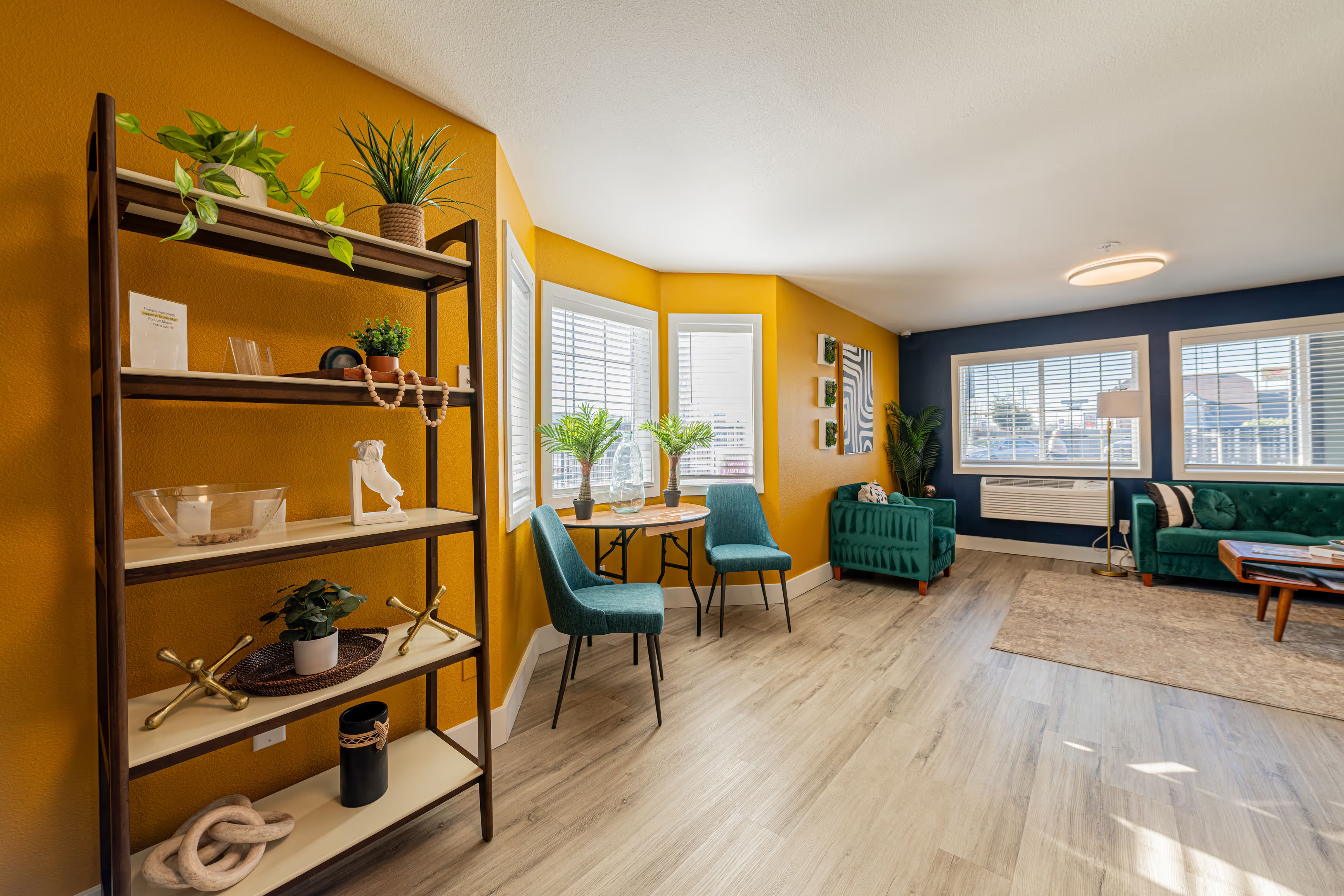
Conversion-focused acquisition companies target specific property characteristics that make adaptive reuse financially viable. Extended-stay hotels with larger room sizes (350+ square feet), separate living areas, and kitchenettes are particularly attractive because they require minimal reconfiguration to function as apartments.
Location factors heavily into conversion economics. Properties near employment centers, universities, hospitals, or transit corridors maintain their value through the conversion process because residential demand follows the same location principles. Zoning that permits multifamily use without requiring variances significantly reduces timeline and execution risk.
Building characteristics matter. Properties with exterior corridor configurations, ample parking ratios (1.5+ spaces per unit), and manageable floor plates convert more efficiently than interior corridor hotels with insufficient parking. The ability to add full kitchens and potentially combine rooms to create unit mix variety (studios, one-bedrooms, two-bedrooms) enhances conversion feasibility.
Speed and Certainty Advantages
Conversion buyers often move faster than traditional hotel buyers because they're not underwriting to hotel performance—they're focused on construction feasibility and apartment market fundamentals. Due diligence centers on structural engineering, zoning verification, and construction cost estimation rather than analyzing STR reports and historical ADR trends.
This can result in 30-45 day close timelines with fewer performance-based contingencies. If your property is struggling with occupancy, faces brand-mandated PIP requirements, or operates below breakeven, conversion buyers may be the only buyer category willing to acquire quickly without requiring extensive operational performance warranties.
Sage Investment Group: The Conversion-Specialist Difference
Sage Investment Group focuses exclusively on acquiring hotels for conversion to apartments, bringing a specialized approach that differs from both traditional hotel buyers and generalist conversion players. With about 30 hotel-to-apartment conversions across six states, Sage has developed a repeatable process for identifying, acquiring, and transforming underutilized hotel properties into vibrant apartment communities.
What distinguishes Sage from other hotel acquisition companies is the combination of deep conversion expertise and a mission-driven focus on creating affordable housing. The company targets properties that can be acquired and converted at approximately 50% of ground-up apartment construction costs, which enables naturally affordable rents while still generating strong returns for investors.
Sage typically acquires properties between 100-200 units in growth markets with robust job and wage growth—specifically Washington, Texas, North Carolina, South Carolina, Indiana, and Alabama. The company looks for extended-stay or mid-scale hotels near employment centers and transit corridors that can be transformed into workforce housing serving essential workers, young professionals, and individuals on fixed incomes.
For hotel owners, the Sage approach offers several advantages. First, acquisition certainty: Sage has completed about 30 conversions and has proven ability to close transactions. Second, speed: the conversion process typically takes 6–12 months from acquisition to stabilized occupancy, providing sellers with confidence in execution capability. Third, flexibility on property condition: Sage underwrites to post-conversion value, which means properties with deferred maintenance or below-market hotel performance may still command attractive pricing based on apartment potential.
How to Identify Serious Buyers
The hotel transaction market includes tire-kickers alongside legitimate buyers. Distinguishing serious acquisition companies from those simply building pipelines requires evaluating several factors.
Track record matters most. Ask for a list of completed acquisitions in the past 24 months with verifiable closing dates and property names. Serious buyers can provide references from recent sellers and demonstrate consistent acquisition activity. Companies that closed deals during challenging market periods (2023-2025) have proven capital availability and execution capability.
Capitalization strength separates real buyers from those dependent on raising funds post-LOI. Ask about capital structure: do they have committed equity, existing funds, or institutional backing? Companies that can provide proof of funds letters within 48 hours of agreeing on price terms are serious. Those requesting 90+ day feasibility periods to line up financing are often not ready to transact.
Deal structure preferences reveal buyer sophistication. Serious buyers propose reasonable due diligence timelines (30-45 days for most properties), limited contingencies beyond standard environmental and title matters, and earnest money deposits that demonstrate commitment (typically 5-10% of purchase price).
Response time and professionalism throughout the negotiation process indicate seriousness. Buyers who take weeks to respond to information requests, frequently renegotiate agreed-upon terms, or introduce new conditions late in the process are red flags. Professional acquisition teams communicate clearly, provide timely responses, and honor their commitments.
Matching Your Property to the Right Buyer
Different property types naturally align with specific buyer categories. Understanding where your property fits helps you target marketing efforts effectively and set realistic price expectations.
Luxury and upper-upscale hotels in major markets appeal to branded operators, PE firms, and REITs. These buyers compete for premier assets, potentially driving valuations toward replacement cost. If your property fits this profile, expect multiple offers and the ability to be selective about buyer quality and terms.
Mid-scale and economy hotels in secondary markets attract regional operators and conversion buyers. These properties trade at wider ranges depending on condition, performance, and potential for both continued hotel operations and alternative uses. Marketing to both hotel operators and conversion specialists maximizes your potential buyer pool.
Distressed or underperforming hotels find their primary market among PE firms, opportunistic funds, and conversion buyers. Traditional hotel operators typically pass on assets requiring significant capital or facing operational challenges. If your property falls into this category, focus outreach on value-add investors and alternative use buyers rather than wasting time with branded operators unlikely to engage.
The 2026 Hotel Transaction Environment
The current market dynamics favor sellers who understand buyer motivations and act decisively. With institutional capital reallocating to hospitality after years focused elsewhere, buyer competition for attractive assets is increasing. However, sellers must price realistically relative to replacement cost and current market fundamentals to attract serious buyers.
Properties trading at 50-60% of replacement cost in many markets create compelling value propositions for multiple buyer types. Yet the gap between buyer and seller valuation expectations continues to narrow as more transactions close and establish pricing benchmarks. Sellers who price based on 2021-2022 valuations will struggle to find buyers; those pricing to current market realities are transacting successfully.
The expansion of conversion-focused buyers has created a viable exit for hotel owners who previously faced limited options. Properties that might have been forced into foreclosure or distressed sales now have a buyer category willing to acquire based on apartment fundamentals rather than hotel performance. This additional liquidity benefits hotel owners, particularly those with properties better suited to residential use than continued hotel operations.
Finding the right hotel acquisition company for your property requires understanding your asset's position within the market, identifying which buyer categories align with its characteristics, and engaging seriously capitalized buyers with proven track records. Whether your property attracts traditional hotel operators, institutional investors, regional owner-operators, or conversion specialists, matching asset to buyer creates the foundation for a successful transaction.
Sage Investment Group is one of the nation's leading hotel acquisition companies specializing in hotel-to-apartment conversions. Learn about our acquisition approach and current projects.
Important Disclosures
This article is for informational purposes only and does not constitute an offer to sell or a solicitation of an offer to buy any securities. Any such offer will be made only through a confidential private placement memorandum or other definitive offering documents to qualified prospective investors. Investments discussed herein are offered exclusively to accredited investors in accordance with Regulation D under the Securities Act of 1933.
Past performance is not indicative of future results. All projections, forecasts, and return targets are provided for illustrative purposes only and are not guarantees of future performance. Investing in real estate involves significant risks, including the potential loss of principal. You should consult your own legal, tax, and financial advisors before making any investment decision.
For more information, please review Sage Investment Group's Privacy Policy.

