
Short answer: Workforce housing is rental housing for households that earn too much to qualify for subsidized housing but struggle with market-rate rents, such as teachers, nurses, and first responders. Investors can access it by buying or converting existing buildings or through private offerings. Sage Investment Group provides workforce housing by converting hotels into apartments: 32 properties and 2,999 units across six states, built through about 30 conversions that typically take 6–12 months. Sage targets an 18–25% IRR and 4–8% annual cash flow distributions. These are targets, not guarantees. Actual results may be lower, distributions may be reduced or suspended, and investors can lose some or all of their investment. For why new construction has not closed the gap, see Why Workforce Housing Stays Scarce Amid New Building.
Workforce Housing Investment: Meeting Demand from Essential Workers
Workforce housing investment represents one of the most compelling opportunities in real estate in 2026—combining strong financial returns with meaningful social impact through impact investing in real estate. This critical housing segment serves essential workers earning 80-120% of area median income (AMI): nurses, teachers, police officers, retail managers, service industry workers, and administrative professionals who form the backbone of functioning communities yet struggle to find quality, affordable housing near their workplaces.
The workforce housing crisis has intensified dramatically. While luxury apartments proliferate in urban cores and deeply subsidized affordable housing serves the lowest income households, the vast middle—working families earning too much for government assistance but too little to afford market-rate housing comfortably—faces severe supply constraints. This "missing middle" represents both acute societal need and durable investment opportunity.
This article examines workforce housing real estate investment in depth: defining the segment, analyzing supply-demand dynamics, explaining why middle income housing investment generates attractive risk-adjusted returns, and detailing how hotel-to-apartment conversions serve this market particularly effectively.
What Is Workforce Housing?
Workforce housing provides quality rental housing affordable to households earning 80-120% of area median income—the income band where most essential workers fall.
Defining the Income Range
Area median income varies by market, but workforce housing targets are consistent:
In Seattle (2026 AMI: ~$115,000): Workforce housing serves households earning $92,000-$138,000 annually.
In Charlotte (2026 AMI: ~$85,000): Target households earn $68,000-$102,000 annually.
In Dallas (2026 AMI: ~$90,000): Workforce housing targets $72,000-$108,000 earners.
These income levels represent:
- Teachers (median $65,000-$75,000)
- Registered nurses (median $75,000-$95,000)
- Police officers (median $65,000-$85,000)
- Retail managers (median $55,000-$75,000)
- Administrative professionals (median $50,000-$70,000)
- Service industry supervisors (median $45,000-$65,000)
For dual-income households, these ranges easily accommodate families where both partners work in essential industries.
What Makes Housing "Affordable"?
Housing is considered affordable when rent consumes no more than 30% of gross household income. For workforce housing tenants:
80% AMI household ($70,000): Affordable rent = $1,750/month 100% AMI household ($87,500): Affordable rent = $2,190/month 120% AMI household ($105,000): Affordable rent = $2,625/month
Workforce housing units typically rent for $1,200-$2,200 depending on market and unit size—significantly below Class A market-rate apartments ($2,500-$3,500+) yet substantially above deeply subsidized affordable housing ($800-$1,200).
Distinguishing Workforce from Other Housing
vs. Luxury/Class A: Workforce housing offers quality finishes and amenities but without premium pricing. Units are newer or renovated, safe, professionally managed, but priced 20-40% below luxury competitors.
vs. Subsidized affordable (30-60% AMI): Workforce housing is naturally affordable through lower development costs and operational efficiencies, not through government rent restrictions or subsidies (though some projects use Low-Income Housing Tax Credits). Tenants qualify based solely on ability to pay, not income verification. For a broader look at how private capital flows into this space, see our guide to investment in affordable housing.
vs. Class C/Older properties: Workforce housing maintains higher quality standards than aging Class C apartments, offering modern finishes, functional amenities, and professional management.
The Workforce Housing Crisis: Supply and Demand Imbalance
Workforce housing faces acute undersupply driven by structural factors unlikely to resolve quickly.
Demand Drivers
Population growth in mid-tier occupations. Healthcare, education, retail, and service industries continue expanding. These sectors employ millions in the 80-120% AMI range and will add millions more jobs over the coming decade.
Household formation. Millennials and Gen Z forming households need housing. Many work in essential industries with incomes squarely in the workforce housing range.
Housing cost burden acceleration. Market-rate housing costs have increased faster than wages. Households formerly able to afford market-rate apartments now require workforce housing to avoid rent burden.
Urban growth patterns. Job growth concentrates in metropolitan areas where housing costs are highest and workforce housing scarcest.
Supply Constraints
Development economics don't work. Ground-up construction costs ($250,000-$350,000 per unit) require rents of $2,200-$3,000+ to generate developer returns. These rents exceed workforce housing affordability.
Land costs prohibitive. In growth markets, land prices push all-in development costs even higher, making workforce housing development financially impractical without subsidy.
Zoning restrictions. Many jurisdictions restrict multifamily development through exclusionary zoning, limiting workforce housing supply even where demand is acute.
Aging stock deterioration. Older apartment properties that once provided workforce housing deteriorate without reinvestment, shrinking quality supply. Converting them requires substantial capital investment with uncertain returns at workforce housing rents.
Competing uses. Developable sites become luxury apartments, condos, or commercial uses generating higher returns than workforce housing. Rational capital allocation starves workforce housing of development activity.
The Result: 7.3 Million Unit Shortage
The National Low Income Housing Coalition estimates the United States needs 7.3 million additional affordable housing units, with the workforce housing segment (80-120% AMI) representing the largest undersupplied category. This shortage is growing, not shrinking—supply additions lag demand by wide margins.
Why Workforce Housing Generates Strong Returns
Despite serving moderate-income tenants, workforce housing real estate delivers attractive risk-adjusted returns through several mechanisms:
Demand Resilience
Workforce housing demonstrates recession-resistant demand. Essential workers retain employment through economic cycles. Unlike luxury tenants who can downsize or move during downturns, workforce housing residents have limited alternatives—they can't afford luxury and don't qualify for deeply subsidized housing. This captive demand creates stability.
Historical data shows workforce housing maintains higher occupancy rates during recessions than luxury apartments. The 2008-2010 downturn saw Class A occupancy drop 400-600 basis points while workforce housing declined only 100-200 basis points.
Moderate Operating Costs
Workforce housing properties operate efficiently:
Lower turnover. Residents with limited affordable alternatives stay longer. Average tenancy of 24-30 months versus 12-18 months for luxury apartments reduces turnover costs.
Reasonable expectations. Workforce tenants appreciate quality housing at affordable rents. They don't demand the premium amenities, concierge services, or constant upgrades luxury tenants expect.
Stable rent growth. While rent growth may lag luxury apartments during boom times, workforce housing maintains steady growth through cycles, compounding reliably over long holds.
Multiple Exit Strategies
Workforce housing properties attract diverse buyers:
Institutional buyers. Large multifamily investors value stable cash flows and resilient demand.
Affordable housing investors. Buyers focused specifically on workforce and affordable housing segments seek proven properties.
Value-add buyers. Properties with operational upside or physical improvement opportunities appeal to value-add investors.
This buyer depth supports liquidity and exit execution.
Tax Efficiency
While workforce housing doesn't require Low-Income Housing Tax Credits (LIHTC), projects can optionally pursue tax credit financing for additional benefits. Regardless, standard real estate tax advantages apply: depreciation deductions, 1031 exchanges, opportunity zone benefits where applicable.
Inflation Protection
Workforce housing provides strong inflation hedges. As wages increase, residents can afford modest rent increases. Unlike subsidized housing with rent caps, workforce housing rents can grow with inflation while remaining affordable.
Hotel Conversions: The Ideal Workforce Housing Solution
Hotel-to-apartment conversions represent perhaps the most effective workforce housing delivery mechanism available in 2026. The strategy addresses supply constraints while generating strong returns.
Economics Enable Workforce Housing Rents
The fundamental advantage: conversions create apartments at approximately 50% of ground-up construction cost by leveraging existing buildings. This cost basis enables workforce housing rents while generating attractive returns.
Example:
- Ground-up construction: $300,000 per unit requires $2,500+ rents
- Hotel conversion: $150,000 per unit achieves strong returns at $1,600-$1,800 rents
The $700-$900 monthly rent differential means conversions naturally serve workforce housing while maintaining 18-25% IRR targets.
Speed Serves Urgent Need
Converting hotels in 6-12 months versus 30-48 months for ground-up development delivers workforce housing when communities need it. This speed benefits investors (faster cash flow) and communities (housing supply quickly).
Location Advantages
Hotels cluster near employment centers, transit corridors, and services—exactly where workforce housing is needed. Essential workers serving hospitals, universities, business districts, and manufacturing can live near work, reducing commutes and improving quality of life.
Quality Exceeds Alternatives
Converted hotels deliver quality comparable to new construction: modern finishes, functional amenities, professional management. Unlike aging Class C apartments providing workforce housing by default, conversions offer intentionally designed quality at naturally affordable rents.
Scale Impact
Single conversion projects deliver 100-200 workforce housing units rapidly. Operators like Sage Investment Group, with 2,999 units across 32 properties, create meaningful workforce housing supply at scale impossible through traditional affordable housing development timelines.
How do hotel-to-apartment conversions create affordable workforce housing?
Hotel-to-apartment conversions create affordable workforce housing by lowering what it costs to produce each apartment. A hotel already has the structure, utilities, parking, and plumbing to every room. A sponsor buys an underperforming hotel, often below replacement cost, and renovates the rooms into studios and one-bedrooms with full kitchens. Because the all-in cost is lower, rents can sit below new Class A apartments and still cover costs, without subsidies or income restrictions. This is called "naturally affordable" housing. Sage Investment Group reports that its converted units typically rent for $300–$500 less per month than similar Class A apartments and are typically the lowest-cost units in their market, even though they live like new construction.
- Lower cost basis: Sage reports completing projects for about 50% of replacement cost thanks to existing infrastructure and depressed hotel values.
- Faster delivery: Sage completes conversions in 6–12 months, versus the 2–4 years typical for new builds.
- Close to jobs: Sage targets hotels near employment centers and transit corridors in markets with strong job and wage growth, so residents can live near work.
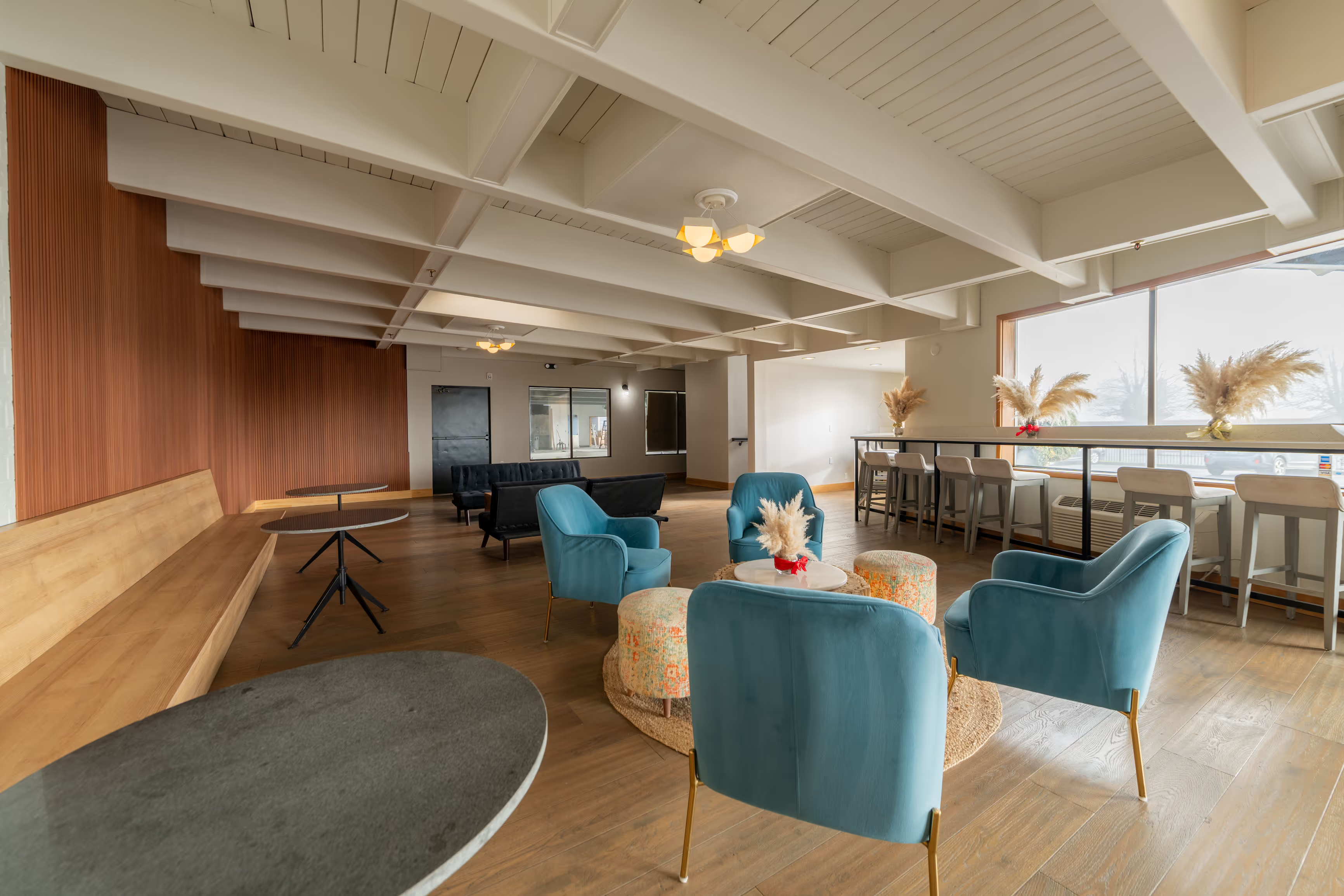
- Quality at a lower rent: Units are fully appointed, with brand-new finishes and full kitchens. Amenities can include internet, cable, dog parks, and sometimes indoor pickleball.
- Serving the missing middle: Many of Sage's residents earn too much to qualify for subsidies but can't afford traditional market rents. In Centralia, WA, 680 households signed up for Sage's workforce apartments before construction began. See the Centralia waitlist story.
- Scale: Sage's portfolio totals 32 properties and 2,999 units across six states. See the portfolio.
Sage Investment Group's offerings are available only to verified accredited investors under SEC Regulation D, Rule 506(c). Learn why Sage converts hotels or explore investing with Sage.
Investment Returns in Workforce Housing
Workforce housing investment generates compelling risk-adjusted returns:
Target Returns
Institutional workforce housing investments target:
- Going-in cap rates: 5.5-6.5%
- Stabilized IRR: 12-18% (value-add projects)
- Cash-on-cash returns: 6-9% stabilized
- Hold periods: 5-10 years
Hotel conversion projects targeting workforce housing can achieve higher returns:
- Target IRR: 18–25% (Sage target)
- Annual cash flow distributions: 4–8% target (Sage)
These are targets, not guarantees. Actual results may be lower, distributions may be reduced or suspended, and investors can lose some or all of their investment.
These returns compare favorably to alternatives while providing substantially lower risk than luxury apartments dependent on economic cycles. For a detailed breakdown, see our analysis of ROI in affordable housing investment.
Return Stability
Workforce housing demonstrates lower volatility than luxury apartments. During 2008-2010, luxury apartment values declined 30-40% in many markets while workforce housing declined only 15-20%. This downside protection matters tremendously for long-term wealth building.
Income Production
Workforce housing produces reliable current income. Properties generate quarterly distributions starting during lease-up and continuing through holds. For investors seeking passive income from real estate, this cash flow is valuable regardless of appreciation.
Sage Investment Group's Workforce Housing Impact
Sage Investment Group provides workforce housing through hotel-to-apartment conversions:
2,999 units across 32 properties serve essential workers in six states: Washington, Texas, North Carolina, South Carolina, Indiana, and Alabama.
Naturally affordable rents typically $300-$500 below comparable Class A apartments while offering similar quality. Units serve the 80-120% AMI segment perfectly.
Proven track record of about 30 conversions demonstrates execution capability and operational excellence.
Sage targets an 18–25% IRR and 4–8% annual cash flow distributions while adding workforce housing where communities need it. These are targets, not guarantees. Actual results may be lower, distributions may be reduced or suspended, and investors can lose some or all of their investment.
Evergreen fund structure allows accredited investors to access diversified workforce housing portfolios with quarterly distributions and potential for long-term appreciation.
For investors seeking exposure to this compelling segment, Sage provides proven access to workforce housing investment through hotel conversion strategies.
For the reasons new construction has not closed the gap, including permitting, land, and construction costs, see Why Workforce Housing Stays Scarce Amid New Building.
For what happens to safety when a problem hotel becomes managed apartments, see Do Hotel-to-Apartment Conversions Reduce Crime?
Conclusion
Workforce housing investment represents a rare convergence: acute societal need, structural supply-demand imbalance, and attractive risk-adjusted returns. As the "missing middle" faces worsening housing affordability while essential workers struggle to find quality housing near employment, investors who address this need while generating strong returns create genuine win-win outcomes.
Hotel-to-apartment conversions deliver workforce housing more effectively than alternatives: lower costs enable affordable rents, rapid timelines serve urgent needs, quality matches modern expectations, and locations near employment centers provide lifestyle benefits. For investors, the strategy aims for competitive returns backed by steady demand and multiple exit strategies.
In 2026's environment, workforce housing real estate stands out as both impactful and profitable—a combination increasingly valuable to sophisticated investors seeking meaning alongside returns.
Ready to explore workforce housing investment? Connect with Sage Investment Group at sageinvestment.com to learn about their diversified portfolio of hotel-to-apartment conversions serving essential workers nationwide.
Important Disclosures
This article is for informational purposes only and does not constitute an offer to sell or a solicitation of an offer to buy any securities. Any such offer will be made only through a confidential private placement memorandum or other definitive offering documents to qualified prospective investors. Investments discussed herein are offered exclusively to accredited investors in accordance with Regulation D under the Securities Act of 1933.
Past performance is not indicative of future results. All projections, forecasts, and return targets are provided for illustrative purposes only and are not guarantees of future performance. Investing in real estate involves significant risks, including the potential loss of principal. You should consult your own legal, tax, and financial advisors before making any investment decision.
For more information, please review Sage Investment Group's Privacy Policy.