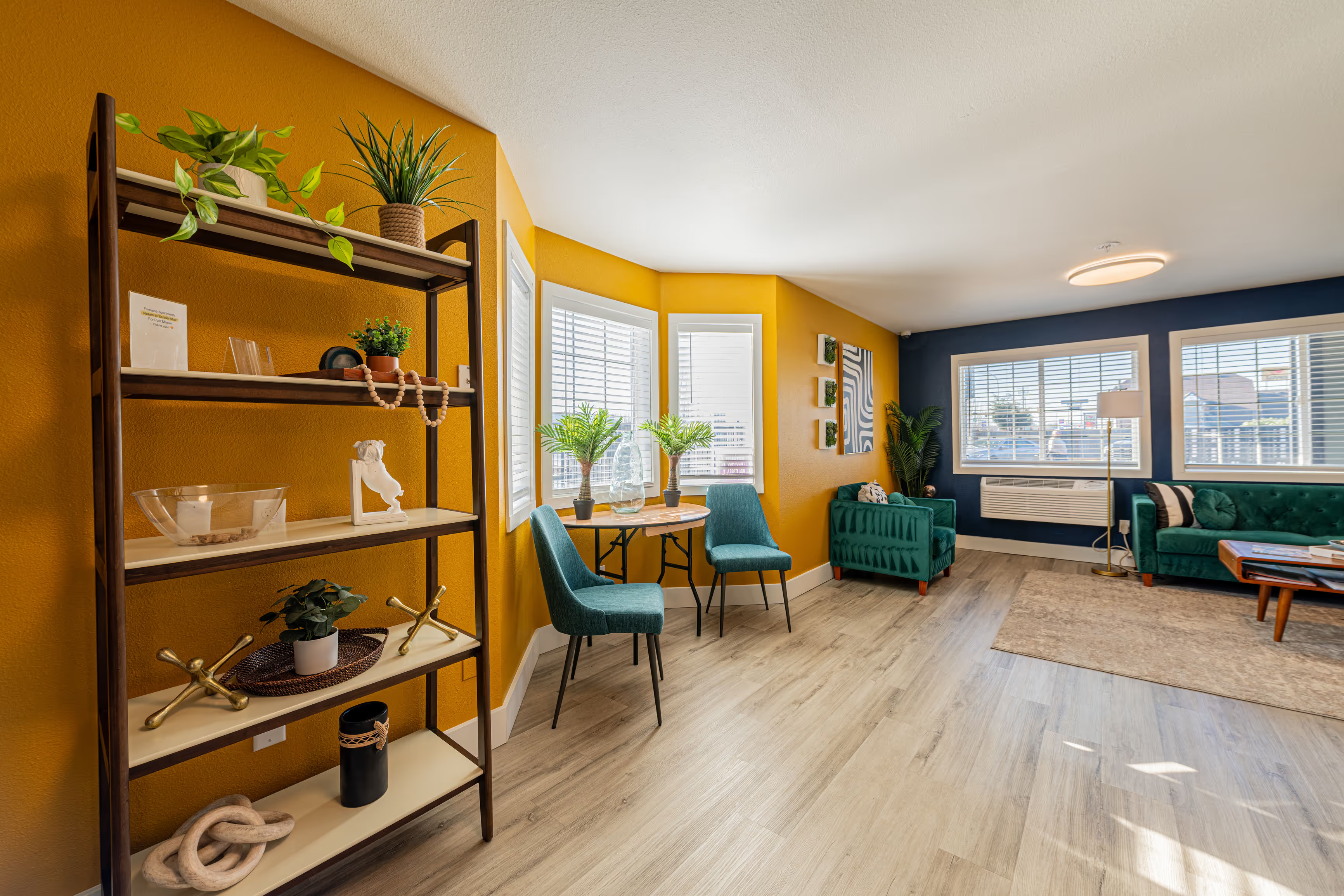

Hotel Buyers: Who Is Buying Hotels in 2026 and What They Look For
Understanding who buys hotels in today's market is essential for property owners considering a sale. The hotel buyer landscape has evolved significantly, with diverse participants bringing different motivations, underwriting criteria, and value propositions to the table. In 2026's shifting hospitality market, knowing what hotel acquisition companies look for—and which buyer type best fits your property—can mean the difference between a successful exit and a stalled listing.
With $48 billion in CMBS maturities creating forced sellers and properties trading at attractive basis levels (50-60% of replacement cost in many markets), sophisticated hotel buyers are returning with conviction. But not all buyers are created equal. Traditional hotel operators, institutional REITs, private equity funds, and specialized conversion buyers each evaluate properties through completely different lenses.
This guide examines the major categories of hotel buyers active in 2026, what each type looks for in acquisition opportunities, their typical timelines and contingencies, and how to position your property to attract the right buyer at the best price.
Traditional Hotel Operators
The most familiar buyer category consists of entities intending to continue operating your property as a hotel.
Independent Operators and Regional Chains
Independent hotel operators and regional chains seek properties that fit their existing portfolio footprint and operational expertise. These buyers typically include:
Family-owned hospitality groups with multi-generational hotel experience in specific regions. They know their local markets intimately and look for properties where their operational knowledge creates competitive advantages.
Regional limited-service operators who have built management expertise around specific brand families (like Choice Hotels, Wyndham, or Best Western flags) and seek properties that fit their systems.
Entrepreneurial operators transitioning from hotel management into ownership, often leveraging SBA 7(a) loans that can finance up to 90% of acquisition cost for owner-operated hotels under $5 million.
What they look for: Traditional operators underwrite conservatively based on current operational performance with modest improvement assumptions. They evaluate:
- Strong current operations. Stabilized occupancy above 60-65%, consistent ADR trends, and demonstrable NOI history. They're buying cash flow, so current performance matters tremendously.
- Brand suitability. Properties already flagged with brands they operate, or unflagged properties suitable for their preferred brands without massive PIPs.
- Manageable capital requirements. Properties in reasonable condition requiring $5,000-$15,000 per key in near-term CapEx. Major renovations frighten many independent operators who lack capital reserves.
- Owner-manageable scale. Independent operators often prefer 60-120 room properties they can personally oversee. Larger properties may exceed their management capacity or comfort level.
Timeline and process: Independent operators typically require 60-90 days for due diligence, often need financing (extending timeline), and frequently involve multiple family members in decision-making. Expect methodical, risk-averse underwriting.
Best fit for: Hotels with stabilized performance, strong market fundamentals, and reasonable physical condition. Properties that are performing well but where owners are ready to exit.
National Brands and Franchisees
Larger franchisee organizations affiliated with major brands (Marriott, Hilton, Hyatt, IHG) acquire properties to expand their brand portfolios.
What they look for:
- Brand conversion potential. Properties suitable for conversion to their preferred flag, even if currently operating under different brands.
- Strict brand standard compliance. The property must meet or be economically brought to brand Property Improvement Plan (PIP) standards. This can require $15,000-$50,000+ per key for conversions.
- Strategic market fit. Properties in markets where their brand lacks presence or where they're consolidating market share.
- Institutional-quality operations. Professional property management systems, strong financial controls, and operational metrics meeting brand benchmarks.
Timeline and process: National franchisees move deliberately through 90-120 day due diligence periods. Brand approval processes add 30-45 days. Financing through hospitality-specialized lenders typically required.
Best fit for: Properties in strong markets where brand conversion makes strategic sense and where the property can economically meet brand standards.
Institutional Investors
Institutional capital—REITs, private equity funds, and family offices—seeks hotels as long-term income-producing assets or value-add repositioning opportunities.
Hotel REITs
Publicly traded hotel REITs like Host Hotels & Resorts, RLJ Lodging Trust, Pebblebrook Hotel Trust, and others acquire select-service, upscale, and luxury properties in gateway markets.
What they look for:
- Upper upscale and luxury properties. REITs focus on higher-quality assets: full-service hotels, upscale select-service, and luxury boutique properties.
- Gateway and resort markets. Primary focus on top 25 MSAs, major resort destinations, and high-barrier-to-entry markets where supply constraints protect values.
- Institutional-quality assets. Pristine condition, strong brands, professional management in place, properties requiring minimal immediate capital.
- Scale transactions. REITs prefer larger deals ($20M+) or portfolio acquisitions. Single limited-service properties under $10M rarely meet their investment criteria.
Timeline and process: REITs offer certainty of close (no financing contingency) but move deliberately through 90-120 day due diligence. Public company oversight means conservative underwriting and extensive approval chains.
Best fit for: High-quality full-service or luxury properties in gateway markets. Properties priced above $20 million. Sellers prioritizing certainty over speed.
Private Equity Funds
Hospitality-focused private equity funds deploy institutional capital into hotel acquisitions, often pursuing value-add strategies.
What they look for:
- Operational upside potential. Properties underperforming due to management issues, deferred capital investment, or weak branding that can be improved.
- Attractive basis. PE funds seek properties trading at significant discounts to replacement cost or properties where renovation investment can create substantial value.
- Repositioning opportunities. Properties where brand conversion, renovation, or operational improvements can drive NOI growth and value creation.
- Scalable opportunities. While PE funds will do single-asset deals, they prefer platforms: multiple properties, regional portfolios, or properties that can anchor broader acquisition strategies.
Timeline and process: PE funds can move quickly (45-75 days) when they identify compelling opportunities. They have higher risk tolerance than REITs but also higher return requirements (typically 15-20%+ IRR targets).
Best fit for: Properties with clear value-add angles, motivated sellers accepting discounts in exchange for speed and certainty, and properties where operational or physical improvements can drive significant value creation.
Conversion Buyers: The Emerging Opportunity
Perhaps the most significant development in the 2026 hotel acquisition market is the growing prominence of specialized conversion buyers who acquire hotels for conversion to alternative uses—primarily apartments.
Who They Are
Conversion specialists like Sage Investment Group, Dominium, and other multifamily developers focus exclusively on acquiring hotels suitable for residential conversion. This buyer category has expanded rapidly as the intersection of three trends:
1. Workforce housing crisis. The United States faces a shortage of 7.3 million affordable homes, with particular scarcity in the 80-120% AMI (area median income) workforce housing segment.
2. Hotel market challenges. Many secondary and tertiary market hotels face structural headwinds: declining occupancy, rising operating costs, and difficulty refinancing debt at current rates.
3. Development cost advantages. Converting existing hotels to apartments costs approximately 50% of ground-up new construction due to existing structure, utilities, parking, and building systems.
What Conversion Buyers Look For
Conversion buyers evaluate properties through completely different criteria than hotel operators:
Property characteristics:
- Room size. Extended-stay hotels and suite properties with rooms 350+ square feet are ideal. Standard select-service rooms (250-300 sq ft) are marginal but workable if acquisition price reflects constraints.
- Building structure and systems. Major building systems (roof, HVAC, plumbing, electrical, envelope) must have remaining useful life. Structural integrity is critical. Cosmetic condition is largely irrelevant since complete interior renovations occur regardless.
- Common area space. Hotel lobbies, breakfast areas, meeting rooms, and fitness centers can be repurposed as residential amenities: community rooms, coworking space, package rooms, fitness centers. Properties with generous common areas are more valuable.
- Building layout. Regular, rectangular floor plates work best for residential. Properties where multiple hotel rooms can be combined into larger units offer flexibility.
Location factors:
- Employment center proximity. Conversions work best near major employers: business districts, hospitals, universities, manufacturing centers. Properties within 15 minutes of job centers are prime candidates.
- Transit access. Access to public transportation or major commuter corridors enhances residential desirability.
- Neighborhood suitability. The location must support residential use. Properties in declining neighborhoods or locations unsuitable for families face challenges.
- Retail and services. Residential tenants need convenient access to grocery stores, restaurants, services, and retail. Isolated locations are problematic.
Zoning and entitlements:
- Residential zoning permitted. The property must be zoned for residential use or obtainable through reasonable process. Many jurisdictions allow residential in zones permitting hotels.
- Parking adequacy. Residential often requires more parking than hotel use (1-1.5 spaces per unit). Surface parking or structured garages satisfy this easily; urban properties with minimal parking may still qualify in jurisdictions with reduced parking requirements.
Market dynamics:
- Strong multifamily fundamentals. Markets with growing population, positive job growth, and constrained housing supply create residential demand justifying conversion investment.
- Development cost challenges. Markets where high land and construction costs make ground-up development difficult are particularly attractive for conversions delivering units at lower rents.
Why Conversion Buyers Can Pay More
The economic logic of conversions creates situations where conversion buyers can offer higher purchase prices than traditional hotel buyers:
Different income underwriting. Hotel operators underwrite to struggling hotel NOI at 8-10% cap rates. Conversion buyers underwrite to stabilized residential NOI at 5.5-6.5% multifamily cap rates. The same building can support materially different valuations based on its highest and best use.
Replacement cost advantage. Acquiring at $75,000-$100,000 per key and investing $50,000-$75,000 per unit in conversion creates apartment units for $125,000-$175,000—roughly 50% of the $250,000-$350,000 cost of ground-up construction in many markets. This cost basis advantage allows conversions to offer below-market rents while generating strong returns.
Speed to stabilization. Conversions reach stabilized occupancy 6-18 months from acquisition versus 30-48 months for ground-up development. Faster cash flow reduces risk and holding costs.
For hotel owners facing refinancing challenges, declining operations, or brand PIP requirements, conversion buyers often represent the most attractive exit option.
Timeline and Process
Conversion buyers typically offer compelling transaction dynamics:
Faster closing. 45-60 days is standard versus 90-120 days for traditional hotel sales. No franchise approval required since conversions terminate hotel operations.
Fewer operational contingencies. Conversion buyers care about structure, location, and residential conversion feasibility—not hotel operational metrics. Declining RevPAR isn't disqualifying; it actually helps by depressing price while preserving the physical asset.
Motivated capital deployment. Specialized conversion buyers execute business strategies requiring regular acquisitions. They're not opportunistically exploring single deals; they're actively deploying capital.
Best fit for: Hotels in strong residential markets, properties with structural integrity but potentially dated hotel operations, extended-stay and suite properties, properties facing refinancing challenges or brand PIP requirements, and motivated sellers prioritizing certainty and speed.
Other Buyer Categories
Several other buyer types occasionally participate in hotel acquisitions:
Private Buyers and Family Offices
High-net-worth individuals and family offices sometimes acquire hotels as lifestyle investments, diversification from other holdings, or legacy assets. These buyers often pay premiums for unique properties (historic hotels, resort properties, boutique assets in desirable locations) but typically have longer decision timelines driven by personal preferences rather than pure financial analysis.
Alternative Use Buyers
Occasionally, buyers see value in converting hotels to uses beyond apartments: senior housing, student housing, extended-stay corporate housing, or even mixed-use redevelopment. These specialized buyers evaluate properties based on their specific use case.
Distressed and Opportunistic Buyers
Specialized distressed buyers acquire hotels from lenders, special servicers, or motivated sellers facing foreclosure, a scenario explored in depth in our guide on how to sell a distressed hotel. They seek significant discounts (30-50% below stabilized value) in exchange for quick closes, cash, and assumption of complicated situations.
Matching Your Property to the Right Buyer
Understanding buyer categories helps position your property effectively:
Premium properties in gateway markets: Target REITs and institutional PE funds.
Stabilized properties with strong operations: Market to traditional operators and franchisees in your brand family.
Properties needing operational improvement: Private equity value-add funds and experienced independent operators.
Underperforming properties in residential markets: Prioritize conversion buyers who can see past current hotel struggles to residential potential.
Unique or boutique properties: Consider private buyers and family offices alongside traditional hotel investors.
The key insight: in 2026's buyer's market, sellers who understand the full spectrum of potential buyers—and particularly those who include conversion specialists in their outreach—consistently achieve better outcomes than those limiting themselves to traditional hotel operators alone.
Conclusion
The hotel buyer landscape in 2026 is diverse, well-capitalized, and increasingly opportunistic. Traditional hotel operators, institutional REITs, private equity funds, and specialized conversion buyers each evaluate properties through distinct frameworks with different strengths and priorities, making it important to understand the full range of hotel exit strategies available.
For hotel owners considering selling, understanding who buys hotels and what each buyer category values allows strategic positioning that maximizes value. Properties that may be unattractive to traditional hotel operators—due to declining performance, upcoming PIP requirements, or market challenges—can be highly compelling to conversion buyers who see different value in the same asset.
As you evaluate selling your hotel, cast a wide net across buyer types. Engage brokers with relationships spanning hotel operators, institutional investors, and conversion specialists. The best buyer for your property may not be the most obvious one.
Ready to explore whether your property might interest conversion buyers? Sage Investment Group, the nation's leading hotel-to-apartment conversion specialist, actively acquires properties nationwide. With 24+ completed conversions across six states and proven closing capability, Sage offers fair valuations, certain closes, and streamlined timelines. Connect with Sage Investment Group at sageinvestment.com to explore your options.
Important Disclosures
This article is for informational purposes only and does not constitute an offer to sell or a solicitation of an offer to buy any securities. Any such offer will be made only through a confidential private placement memorandum or other definitive offering documents to qualified prospective investors. Investments discussed herein are offered exclusively to accredited investors in accordance with Regulation D under the Securities Act of 1933.
Past performance is not indicative of future results. All projections, forecasts, and return targets are provided for illustrative purposes only and are not guarantees of future performance. Investing in real estate involves significant risks, including the potential loss of principal. You should consult your own legal, tax, and financial advisors before making any investment decision.
For more information, please review Sage Investment Group's Privacy Policy.
You may also be interested in our article on hotel acquisition companies.