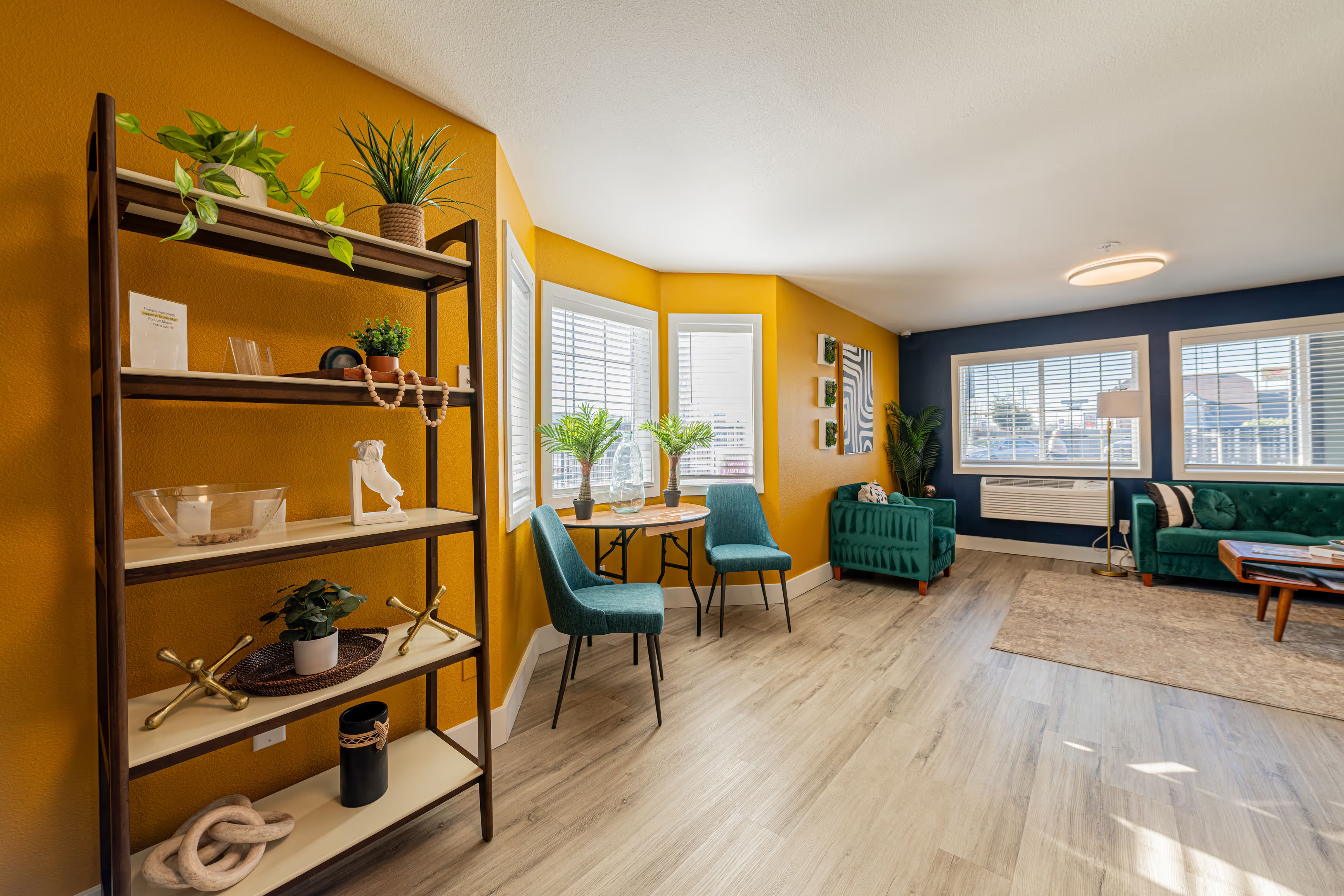

A quiet transformation is reshaping hotel transactions in 2026. Across secondary and tertiary markets nationwide, hotel owners facing challenging operations, refinancing headwinds, or brand upgrade requirements are discovering an unexpected exit option: selling to conversion buyers who transform hotels into apartment communities. These hotel conversion opportunities represent a win-win scenario where struggling hospitality assets become thriving residential properties—and where hotel owners often receive better pricing and terms than traditional hotel buyers can offer.
The rise of hotel to apartment conversion sales reflects converging market dynamics: the nation's 7.3 million-unit affordable housing shortage, structural challenges facing many hotel properties, and the compelling economics of adaptive reuse that allow conversion buyers to acquire at approximately 50% of replacement cost. For hotel owners, understanding why conversion buyers can pay more—and which properties attract their interest—opens new possibilities for successful exits.
This article examines the growing market for hotel conversion opportunities, why conversion buyers offer compelling advantages for sellers, the economics enabling them to pay premium prices, and how to evaluate whether your property might be attractive for adaptive reuse hotel sale.
The Convergence Creating Conversion Opportunities
Short answer: The strongest hotel conversion opportunities are usually limited-service and extended-stay hotels in markets with job growth, where the building's layout suits apartments and the price reflects weak hotel income rather than apartment value. Sage Investment Group has built a portfolio of 32 properties and 2,999 units across six states by pursuing these opportunities through about 30 hotel-to-apartment conversions.
Three powerful trends have converged to create an expanding market for hotel conversions in 2026:
The Affordable Housing Crisis Intensifies
The United States faces an acute shortage of 7.3 million affordable homes, up 8% since 2019. This shortfall is particularly severe in the workforce housing segment—housing affordable to essential workers earning 80-120% of area median income. Teachers, nurses, police officers, retail workers, and service industry employees struggle to find quality housing within reasonable commutes of employment centers.
This shortage isn't temporary or localized. Population growth, household formation, and decades of underbuilding have created structural supply constraints that won't resolve quickly. New apartment construction faces escalating costs: land prices, materials, labor, permitting delays, and construction financing at elevated rates make ground-up development economically challenging in many markets.
Workforce housing demand creates durable, predictable residential income streams that conversion buyers can underwrite confidently. Unlike luxury apartments vulnerable to economic cycles, workforce housing demonstrates resilient demand through varying economic conditions.
Hotel Markets Face Structural Challenges
While luxury hotels in gateway markets continue thriving, many secondary and tertiary market hotels—particularly select-service and limited-service properties—face headwinds:
Operating cost pressures. Labor costs have increased dramatically post-pandemic. Utilities, insurance, and supplies have risen faster than revenue, compressing margins and NOI.
Debt maturity challenges. Hotels financed between 2020-2022 face refinancing at significantly higher rates. Many properties that cash-flowed adequately with 3-4% debt now struggle with 7-8% rates. Hundreds of billions in CMBS maturities through 2026-2027 will force owners to either refinance at higher costs or sell.
Brand PIP requirements. Major hotel brands mandate periodic property improvement plans requiring substantial capital investment. Properties facing $2-5 million PIP requirements may not generate returns justifying that investment, particularly if market fundamentals don't support higher rates post-renovation.
Evolving travel patterns. Remote work and changing business travel patterns have structurally reduced demand in some markets. Properties dependent on corporate travel may face permanent demand challenges.
These challenges create motivated sellers—hotel owners recognizing that continuing operations requires capital investment with uncertain returns, or that refinancing proves economically challenging, prompting many to explore their hotel asset disposition options.
Conversion Economics Create Value
The economics of hotel-to-apartment conversions have become increasingly compelling. Acquiring existing hotel buildings and converting them to apartments costs approximately 50% of ground-up new construction because:
Existing structure and systems. The building envelope, foundation, framing, plumbing risers, electrical service, HVAC infrastructure, and parking exist. Ground-up development must build all of this from scratch.
Entitled, permitted sites. Hotel sites are already entitled and permitted for development. Ground-up projects face months or years navigating entitlements, zoning approvals, and permitting processes.
Faster development timeline. Conversions complete in 6–12 months versus 30-48 months for ground-up development. This speed advantage reduces construction financing duration, holding costs, and market risk while accelerating stabilized cash flow.
These advantages allow conversion buyers to create apartment units for $125,000-$175,000 that would cost $250,000-$350,000 built from scratch—a basis advantage that supports both higher acquisition prices and below-market rents generating strong returns.
Why Conversion Buyers Can Pay More Than Hotel Operators
The most important insight for hotel owners: conversion buyers frequently justify higher purchase prices than traditional hotel buyers. This isn't speculation or optimism—it reflects fundamental differences in how these buyer types underwrite value.
Different Income Potential
Traditional hotel buyers underwrite to hotel NOI. If your property generates $800,000 in hotel NOI and hospitality cap rates in your market are 8.5%, your property's value to a hotel buyer is approximately $9.4 million ($800,000 ÷ 0.085).
Conversion buyers underwrite differently. They evaluate stabilized residential NOI potential. That same property converted to apartments might generate:
- 100 units at $1,200 average rent = $120,000 monthly = $1,440,000 annual gross rental income
- Less 40% operating expenses and vacancy = $864,000 residential NOI
- At multifamily cap rates of 6.0% = $14.4 million value ($864,000 ÷ 0.06)
Even after accounting for $4-5 million in acquisition and conversion costs, residential value substantially exceeds hotel value. This spread allows conversion buyers to pay more than hotel operators while achieving attractive returns.
Lower Operating Cost Structure
Apartment operations are fundamentally simpler and cheaper than hotel operations:
No daily housekeeping. Hotels require cleaning every occupied room daily. Apartments turn units only between tenancies.
No front desk staffing. Hotels need 24/7 front desk coverage. Apartments require modest leasing and maintenance staff during business hours.
No breakfast service, pools, business centers. Hotel operating costs include amenities that drive expenses without direct revenue. Apartment amenities are simpler and cheaper to operate.
Lower insurance and utilities. Residential properties typically enjoy lower insurance costs than hotels and can separately meter utilities, passing costs to tenants.
These operational efficiencies mean conversion buyers can underwrite higher NOI margins than hotels generate—further supporting higher valuations.
Risk-Adjusted Return Profiles
Multifamily investments are perceived as lower risk than hotel investments by capital markets:
More predictable cash flows. Annual leases create 12-month visibility into income. Hotel revenue fluctuates daily based on occupancy and ADR.
Less economic sensitivity. Workforce housing demonstrates resilient demand through economic cycles. Hotels, especially upper-tier properties, show greater volatility.
Lower operational complexity. Fewer moving parts and simpler operations reduce execution risk.
These risk characteristics allow multifamily investments to trade at lower cap rates (higher valuations) than hotel properties—compressing yields investors require and supporting higher prices.
Speed and Certainty for Sellers
Beyond price, conversion buyers offer transaction advantages:
Faster closings. Conversion buyers typically close in 45-60 days versus 90-120 days for traditional hotel sales. No franchise approval required since conversions terminate hotel operations.
Fewer contingencies. Declining hotel performance doesn't disqualify properties for conversion buyers—in fact, it helps by depressing price while preserving physical value. PIP requirements become irrelevant. Cosmetic deferred maintenance is immaterial since complete renovations occur anyway.
Motivated capital deployment. Specialized conversion buyers execute business models requiring regular acquisitions. They're actively deploying capital, not opportunistically exploring single deals.
For sellers, these factors translate to higher probability of closing, less renegotiation during due diligence, and greater certainty of outcome.
What Makes Properties Attractive for Conversion
Not all hotels work for conversion, but many more qualify than owners realize. Conversion buyers evaluate properties across several dimensions:
Physical Characteristics
Room size matters most. Extended-stay hotels and suite properties with rooms 350+ square feet are ideal. Standard select-service rooms (250-300 sq ft) are marginal but can work depending on acquisition price and market rents. Full-service hotels with larger rooms and suites are excellent candidates.
Building condition. While cosmetic condition is secondary, major building systems must function: roofs, HVAC, plumbing, electrical, structural elements. Properties with failing systems or significant water damage face challenges. But properties with dated décor, worn FF&E, or cosmetic issues are fine—these get replaced during conversion anyway.
Layout and configuration. Regular, rectangular floor plates work best. Properties where multiple rooms can be combined into larger units, or where existing suites become multi-bedroom apartments, offer flexibility valued by conversion buyers.
Common areas. Hotel lobbies, breakfast areas, meeting rooms, and fitness centers repurpose into residential amenities: community rooms, coworking space, package rooms, fitness centers. Properties with generous common areas are more attractive.
Location Fundamentals
Employment proximity. Conversions succeed near major employment centers where workforce housing demand is strongest. Properties within 15 minutes of business districts, hospitals, universities, or manufacturing centers are particularly attractive.
Transit access. Access to public transportation or major commuter corridors enhances residential desirability.
Neighborhood quality. The location must support residential use. Properties in areas with reasonable safety, access to retail and services, and neighborhood stability work best.
Retail and amenity access. Residential tenants need convenient access to grocery stores, restaurants, services, and retail. Properties near commercial corridors succeed; isolated locations face challenges.
Market Dynamics
Multifamily fundamentals. Strong conversion markets exhibit growing populations, positive job growth, and constrained housing supply creating residential demand.
Development cost barriers. Markets where high land and construction costs make ground-up development difficult are ideal for conversions delivering units at lower costs.
Rent levels. Conversion buyers need market rents high enough to generate attractive returns on total investment. Markets with median rents below $900-1,000 for one-bedroom units may not support conversion economics.
Zoning and Entitlements
Residential zoning. Properties must be zoned for residential use or obtainable through reasonable process. Many jurisdictions permit residential in zones allowing hotels, but this varies by market.
Parking adequacy. Residential typically requires more parking than hotel use. Properties with surface parking or structured garages easily accommodate this. Urban properties with minimal parking may qualify in jurisdictions with reduced parking requirements or transit-oriented development incentives.
Success Stories: Hotel Owners Who Chose Conversion Sales
Across the country, hotel owners are discovering the advantages of selling to conversion buyers:
The secondary market extended-stay property. A 120-room extended-stay hotel in a Midwestern market faced declining occupancy (from 75% pre-pandemic to 58% in 2025), upcoming brand PIP requirements exceeding $2 million, and debt maturing in 2026. The owner received offers from hotel operators at $7.5 million based on depressed NOI. A conversion buyer offered $9.8 million, closed in 52 days with minimal contingencies, and transformed the property into 110 apartments serving local hospital and university employees. The owner achieved 31% higher proceeds and avoided expensive PIPs.
The aging full-service hotel. A 180-room full-service hotel built in 1998 struggled with dated facilities, rising operating costs, and competition from newer properties. RevPAR had declined for three consecutive years. The owner explored selling to hotel operators at $12-13 million but faced extensive due diligence, multiple contract renegotiations, and eventual deal failures. A conversion buyer purchased for $15.2 million, closed in 60 days, and converted the property into 160 apartments plus ground-floor commercial space. The owner received 17% more than the best hotel operator offer and experienced a smooth transaction.
The refinancing-challenged property. A 95-room select-service hotel performed adequately but faced 2026 loan maturity with a $6.5 million balance. At current rates, debt service would consume 85% of NOI, making refinancing impractical. Rather than distressed sale to a lender or short-term extension with punitive terms, the owner sold to a conversion buyer for $8.1 million, paid off the loan, and walked away with meaningful equity. The conversion buyer saw an attractive residential opportunity where hotel economics no longer worked.
These examples illustrate a pattern: properties challenged as hotels become valuable as apartments, and conversion buyers can offer better terms than the hotel market provides.
How to Explore Conversion Opportunities for Your Property
If your hotel faces operational challenges, refinancing headwinds, or upcoming capital requirements, exploring conversion buyer interest makes strategic sense:
Conduct Preliminary Assessment
Evaluate whether your property exhibits characteristics conversion buyers seek:
- Room sizes above 300 square feet
- Location near employment centers in markets with workforce housing need
- Reasonable structural condition with functional major systems
- Zoning permitting or obtainable for residential use
If your property checks these boxes, conversion buyers may offer compelling alternatives to hotel operators.
Engage Specialized Brokers
Work with brokers experienced in both hotel sales and conversion transactions. They maintain relationships with hotel acquisition companies and can position your property effectively across buyer types.
Contact Conversion Specialists Directly
Major conversion buyers actively seek acquisition opportunities. Companies like Sage Investment Group—the nation's leading hotel-to-apartment conversion specialist with about 30 conversions across six states—welcome direct outreach from hotel owners. Initial conversations are exploratory and non-binding, providing insight into whether your property qualifies and potential valuation.
Compare Offers Across Buyer Types
Don't assume hotel operators offer the best value. Simultaneously market to traditional hotel buyers and conversion specialists, comparing not just price but timeline, contingencies, and probability of close.
How to Screen a Hotel Conversion Opportunity
Whether you own a hotel or invest in conversions, the same questions decide whether a property is a real opportunity:
- Building type. Extended-stay and limited-service hotels usually convert more easily than full-service hotels.
- Room layout and plumbing. Rooms need to be large enough for apartments, with plumbing that can serve new kitchens.
- Location. Properties near jobs, transit, and services lease up faster as apartments.
- Zoning path. Residential use must be allowed, or approvable, at the site.
- Price versus finished value. Purchase plus renovation has to come in well below what comparable apartments are worth.
- Rental demand. The local market has to support the projected rents.
For the investor side of these questions, see How Hotel-to-Apartment Conversions Manage Investor Risk and Extended-Stay Hotel Conversions. For owners, see How to Sell Your Hotel.
Conclusion
Hotel conversion opportunities represent a significant and growing exit avenue for hotel owners in 2026. As the intersection of affordable housing demand, hotel market challenges, and compelling conversion economics expands, more owners are discovering that conversion buyers offer superior value to traditional hotel purchasers—particularly for properties facing operational headwinds, refinancing challenges, or capital requirements.
The key insight: struggling hotel operations don't necessarily mean low property value. Conversion buyers see past current hotel performance to underlying residential value—and frequently justify purchase prices that exceed what hotel operators can pay.
For hotel owners exploring exit options, including conversion buyers in your outreach expands possibilities and often improves outcomes. Whether your property is thriving or challenged, understanding hotel conversion opportunities ensures you're maximizing value and identifying all potential buyers.
Ready to explore whether your property interests conversion buyers? Contact Sage Investment Group at sageinvestment.com to discuss your hotel's conversion potential. With proven expertise, fair valuations, and streamlined closing processes, Sage helps hotel owners achieve successful exits while creating much-needed affordable housing.
Important Disclosures
This article is for informational purposes only and does not constitute an offer to sell or a solicitation of an offer to buy any securities. Any such offer will be made only through a confidential private placement memorandum or other definitive offering documents to qualified prospective investors. Investments discussed herein are offered exclusively to accredited investors in accordance with Regulation D under the Securities Act of 1933.
Past performance is not indicative of future results. All projections, forecasts, and return targets are provided for illustrative purposes only and are not guarantees of future performance. Investing in real estate involves significant risks, including the potential loss of principal. You should consult your own legal, tax, and financial advisors before making any investment decision.
For more information, please review Sage Investment Group's Privacy Policy.
You may also be interested in our article on hotel conversion to apartments.