


Why Workforce Housing Stays Scarce Amid New Building: 8 Causes Investors Should Understand
Short answer: Workforce housing stays scarce even when apartment construction booms because most new units are built at rents only higher-income renters can afford. At the same time, older low-rent units are disappearing, rents have grown faster than incomes for two decades, and subsidies rarely reach households in the middle. The result is plenty of new supply at the top of the market and a persistent shortage for teachers, nurses, tradespeople, and service workers. Hotel-to-apartment conversions are one way to add units at workforce rents faster and at a lower cost basis than ground-up construction.
The U.S. just finished one of its biggest apartment-building waves in decades. According to Harvard's Joint Center for Housing Studies (JCHS), 608,000 multifamily units were completed in 2024, the highest annual volume since 1986, and another 488,000 were added in 2025. Yet JCHS also reports that the number of cost-burdened renter households reached a new all-time high of 22.7 million in 2024. How can both be true? Here are the causes.
1. New construction only pencils at high rents
Building an apartment from the ground up has become dramatically more expensive. JCHS reports that the cost of all material inputs to new residential construction rose 42% between January 2020 and December 2025, and labor costs are up too, with the employment cost index JCHS cites rising 24.1% since January 2020. Add land, permitting, and financing costs, and a new unit has to command a top-of-market rent to justify the investment. Developers aren't ignoring workforce renters by choice. At today's costs, conventional financing simply doesn't support new buildings at workforce rents. (We dig into the math in The Missing Middle.)
2. The new supply is aimed at higher-income renters
Large buildings accounted for 75% of the net growth in rental stock between 2010 and 2024, according to JCHS. Those are typically amenity-rich Class A projects. Demand at the top has been real: JCHS reports that renter households earning $75,000 or more (inflation-adjusted) grew by 1.7 million from 2021 to 2024. New supply has been absorbed largely by renters who could afford it, not by the median renter, whose household income was $53,700 in 2024.
3. Low-rent units are disappearing faster than they're replaced
While new luxury units come online, the affordable end of the stock is shrinking. Even after adjusting for inflation, the number of U.S. units renting for less than $600 fell by 2.5 million, or 30%, between 2014 and 2024, according to JCHS. Some of these units are demolished, some are renovated and re-rented at higher prices, and some simply age out of habitable condition. New construction at the top doesn't replace what's lost at the bottom.
4. Rents have outrun paychecks for two decades
JCHS reports that from 2001 to 2024, the inflation-adjusted median rent rose 30%, while the median renter household income rose just 9%. Even in the recent strong economy, median rent grew 12% from 2019 to 2024 while income grew 4%. When rents rise three times faster than wages, households that were comfortably housed a decade ago become stretched, and they compete for the same shrinking pool of moderately priced units.
5. Cost burdens have climbed into the middle class
Affordability is no longer only a low-income problem. JCHS found that among renters earning $45,000 to $74,999, just over 49% were cost burdened in 2024 (spending more than 30% of income on rent and utilities), up 24.3 percentage points since 2001. Among those earning $30,000 to $44,999, 72% were burdened. These are the incomes of many essential workers.
6. Subsidies don't reach the "missing middle"
Federal rental assistance reaches only a fraction of eligible low-income households. JCHS reports that just over one in four income-eligible renter households receive any form of assistance. Programs like the Low-Income Housing Tax Credit primarily target lower-income households. Workforce renters fall into the gap: they earn too much to qualify for subsidies but not enough to afford new Class A rents. That's the segment we describe as the missing middle.
7. The existing stock is old and getting more expensive to run
U.S. rental units have never been older. JCHS puts the median age at 45 years as of 2023, and estimates that 18.8 million renter-occupied units needed at least one repair in 2024. Operating costs are also climbing: multifamily property insurance costs doubled between 2019 and 2024. Owners of older buildings face a choice between deferring maintenance and raising rents to fund upgrades. Either way, the supply of decent, affordable workforce units is squeezed.
8. Vacancies at the top don't trickle down fast enough
In theory, new luxury units free up older ones as renters move up, a process called "filtering." In practice, filtering is slow and uneven. JCHS reports that apartment vacancy rose to 5.2% in the fourth quarter of 2025 as completions outpaced demand, while cost burdens hit records at the same time. A soft market for new Class A units can coexist with a tight market for apartments that working households can actually afford, especially near the jobs they hold.
How hotel-to-apartment conversions add workforce units faster and cheaper
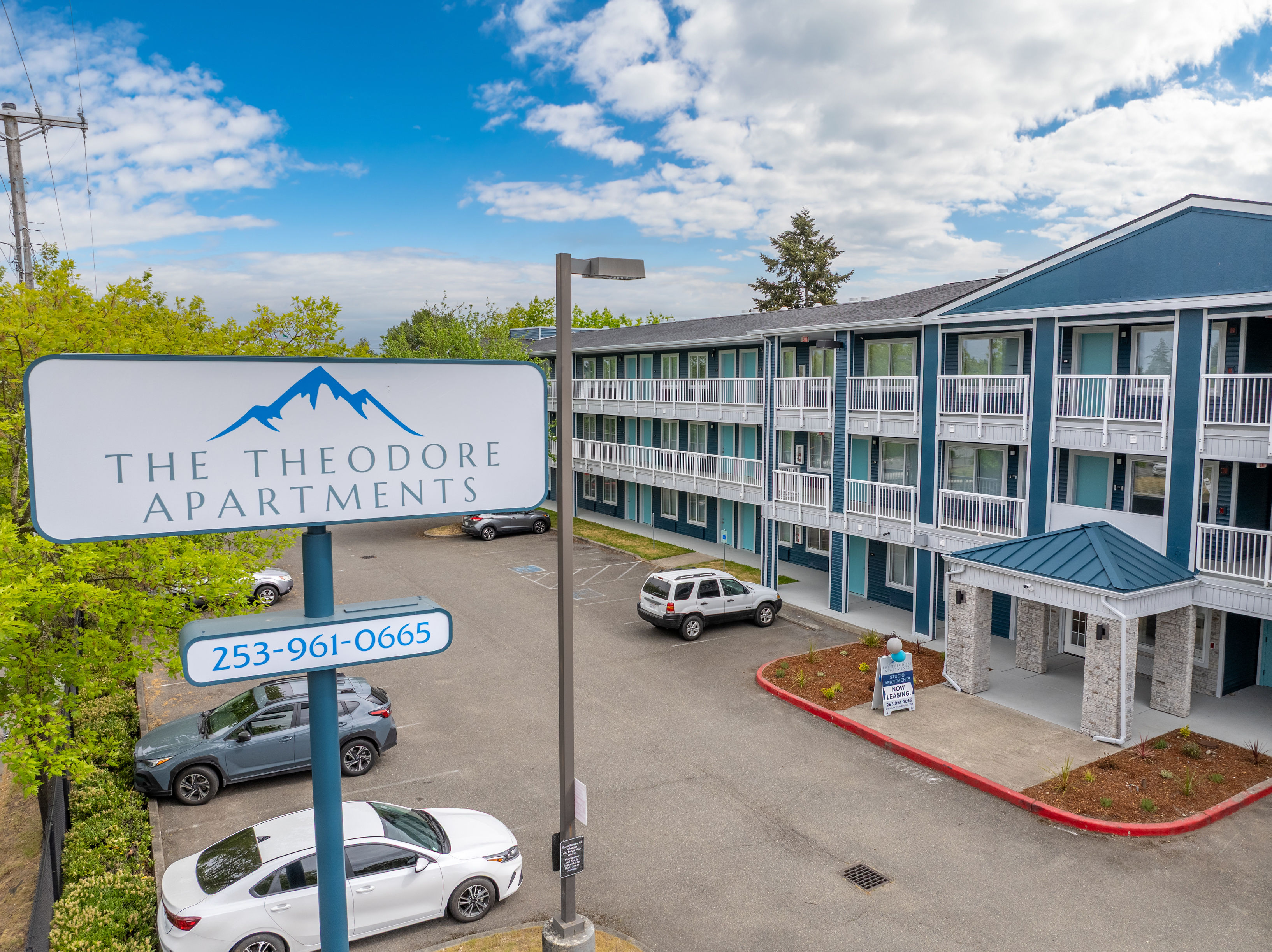
If the core problem is that new units are too expensive to build at workforce rents, the answer is to lower the cost of creating each unit. Hotel-to-apartment conversion does exactly that.
- The building already exists. A limited-service or extended-stay hotel already has the structure, utilities, parking, and plumbing in every room. Renovation focuses on adding full kitchens, new finishes, and residential amenities rather than building from the foundation up.
- A lower cost basis supports lower rents. Sage Investment Group reports completing projects for about 50% of replacement cost, thanks to existing infrastructure and depressed hotel values. That basis is why Sage's units typically rent for $300–$500 less per month than similar Class A apartments, without subsidies or income restrictions.
- Months, not years. Sage completes conversions in 6–18 months, compared with the 2–4 years typical for new builds, so housing reaches the market while the need is urgent.
- Located near work. Hotels are often located near employment centers and transit corridors. Sage targets hotels of roughly 100–200 units in markets with strong job and wage growth, close to employment centers and transit corridors.
- The demand is there. In Centralia, Washington, 680 households signed up for Sage's workforce apartments before construction began. (Read the Centralia story.)
Sage Investment Group, based in Kirkland, Washington, has built a portfolio of 32 properties and 2,999 units across six states, primarily through hotel-to-apartment conversions. Conversions aren't the only answer to the workforce housing shortage. Zoning reform, public investment, and new construction all matter. But conversions are one of the few tools that can add units at workforce rents quickly and without ongoing subsidies.
What this means for investors
For accredited investors, the workforce housing gap is both a social problem and a durable source of renter demand. Strategies that can deliver quality units at rents below new construction serve a large, underserved pool of renters. To learn more about the segment, see Workforce Housing Investment and The Missing Middle. To see how Sage structures its offerings, visit Invest with Sage.
Sage Investment Group's offerings are available only to verified accredited investors under SEC Regulation D, Rule 506(c). This article is for educational purposes only and is not an offer to sell or a solicitation of an offer to buy any security. All investments involve risk, including the possible loss of principal.
Sources
Harvard Joint Center for Housing Studies, America's Rental Housing 2026 (accessed October 4, 2026). Sage Investment Group figures are from sageinvestment.com.