
Why Do Hotel-to-Apartment Conversions Appeal to Real Estate Investors?
Short answer: Hotel-to-apartment conversions appeal to investors because they turn an existing, often underperforming hotel into rental housing faster than building new. The investor buys a building priced on weak hotel income and aims to own a stabilized apartment property worth more. Apartment leases also tend to produce steadier income than nightly room revenue, and demand for housing that working households can afford is strong in many markets. Sage Investment Group, a Kirkland, Washington sponsor that focuses on this strategy, has built a portfolio of 32 properties and 2,999 units across six states through about 30 conversions. Its conversions typically take 6–12 months. The trade-off is execution risk: zoning, building condition, renovation cost, and lease-up all have to go to plan.
Six Reasons Investors Look at Conversions
1. A faster path to rental income
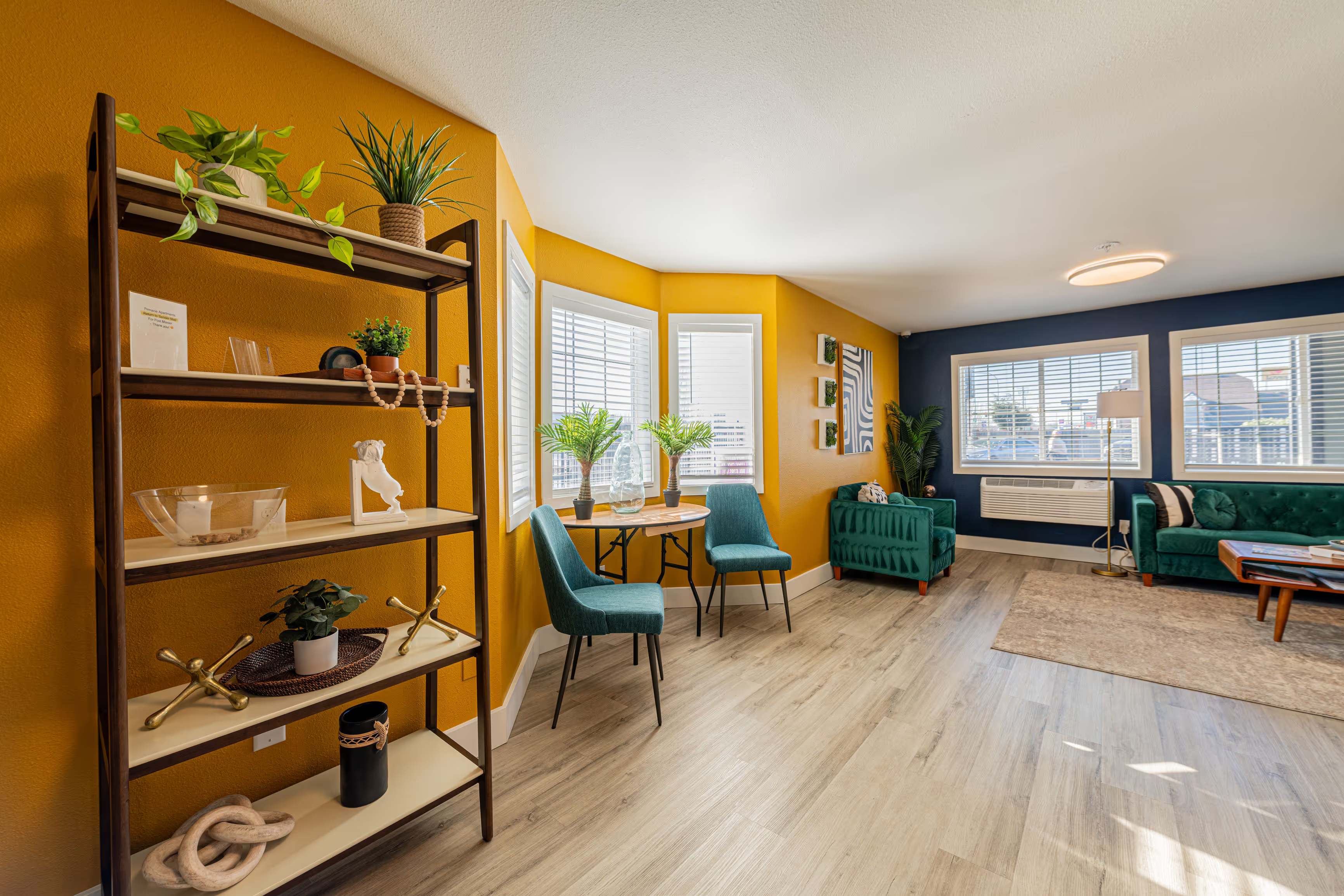
New apartment buildings can take years to entitle and build before the first rent check. A conversion starts with a finished structure, so the work is mostly interior: kitchens, finishes, systems, and amenities. Sage's conversions typically take 6–12 months, which shortens the time investor capital sits idle before units can be leased.
2. Buying at a hotel price, aiming for an apartment value
A struggling hotel is usually valued on its hotel income. A stabilized apartment building is valued on its rents, by a different and often larger pool of buyers and lenders. Conversion investors aim to capture the difference. Sage reports a current portfolio value of $428M and a stabilized value of $482M. The gap shows that much of the value in this strategy depends on finishing renovations and leasing up.
3. Steadier income after stabilization
Hotel revenue changes daily with travel and the economy. Apartment income comes from leases, so occupancy and rents tend to move more slowly. That can make a converted property easier to finance and easier to value once it is stabilized.
4. Strong demand for workforce housing
Much new apartment construction is aimed at higher-income renters. Teachers, nurses, tradespeople, and service workers often have fewer choices. Converted hotels usually become studios and one-bedroom units, which fit many of these households. (See Why Workforce Housing Stays Scarce.)
5. Useful locations and existing infrastructure
Many hotels sit along highways, near job centers, or close to transit. They also come with parking, utilities, and a bathroom in every room, which reduces the scope compared with building new.
6. Adaptive reuse instead of demolition
Reusing a building keeps it in service and avoids demolition and a full rebuild. For investors who care about impact, a conversion adds housing and returns an underused property to productive use. (See Adaptive Reuse Real Estate.)
Common Conversion Strategies in the United States
- Limited-service and extended-stay hotels to studios and one-bedrooms. These buildings often have room sizes and plumbing layouts that suit apartments. (See Extended Stay Hotel Conversion.)
- Workforce housing near employment centers. Targeting renters who earn too much for subsidized housing but are priced out of new Class A buildings.
- Distressed acquisitions. Buying hotels with weak operations, deferred maintenance, or debt pressure, where conversion offers a better use than continued hotel operation.
- Portfolio or fund approach. Spreading capital across several conversions and markets instead of a single building, which reduces dependence on any one project.
Who Conversions May Suit
Conversion offerings are private placements, so they usually suit investors who:
- Qualify as accredited investors and can verify that status;
- Can hold an illiquid investment for several years;
- Want real-asset exposure that is not tied to public markets day to day;
- Are comfortable with construction and lease-up risk in exchange for the potential upside; and
- Value a measurable housing impact alongside financial goals.
High-net-worth individuals and family offices often weigh conversions alongside other private real estate, private credit, and private equity. For a side-by-side comparison, see Best Investments for Accredited Investors in 2026.
The Trade-Offs
Conversions are not automatically cheaper or safer. The main risks are zoning and change-of-use approvals, hidden building problems, layouts that do not translate into good apartments, renovation overruns, slower-than-planned lease-up, and the illiquidity of private offerings. Sponsor experience matters a great deal. For a full breakdown, see How Hotel-to-Apartment Conversions Manage Investor Risk and Hotel Conversion vs Ground-Up Development.
How Investors Participate With Sage
Sage Investment Group's offerings are open only to verified accredited investors under SEC Regulation D, Rule 506(c). Sage targets an 18–25% IRR and 4–8% annual cash flow distributions. These are targets, not guarantees. Actual results may be lower, distributions may be reduced or suspended, and investors can lose some or all of their investment.
To learn more, read Why Conversions, review the Sage portfolio, meet the team, or visit Invest with Sage. Questions? Contact investor relations.
To see which properties make the strongest candidates, read Hotel Conversion Opportunities: Which Hotels Convert Best.
For the valuation math behind buying at a hotel price, see Cap Rate Arbitrage in Hotel-to-Apartment Conversions.
New to the strategy? Start with our complete guide to hotel-to-apartment conversion.
Frequently Asked Questions
Why are investors interested in converting hotels to apartments?
Conversions can deliver housing faster than new construction, start from a cost basis tied to weak hotel income, and end with apartment income that is generally steadier than hotel revenue. Demand for workforce housing supports the strategy in many markets.
Are hotel-to-apartment conversions a good investment?
They can fit investors who can hold an illiquid investment and accept construction and lease-up risk. Results depend on the building, the market, and the sponsor. No outcome is guaranteed.
How long does a hotel-to-apartment conversion take?
It varies by building and approvals. Sage Investment Group's conversions typically take 6–12 months.
What returns do hotel conversion investments target?
Targets vary by sponsor and offering. Sage targets an 18–25% IRR and 4–8% annual cash flow distributions. These targets are not guaranteed and actual results may differ materially.
This article is for educational purposes only and is not an offer to sell or a solicitation of an offer to buy any security. Target returns and distributions are not guaranteed. All investments involve risk, including the possible loss of principal. Past performance does not guarantee future results.